Episode 75
Travelling Light E075S02 Transcript
[Title music: rhythmic electronic folk.]
H.R. Owen
Travelling Light: Episode Seventy Five.
[The music fades out.]
The Traveller
13th Enu 851
To the community at Emerraine, who carry the Light.
Whenever the Guillemot is on approach to land, Oyan, Masha and Scarry are required to be at their posts. But the rest of us are free to do as we please.
Ordinarily, Tarlin stays in the galley while Resimus prepares for the work of loading and unloading once we arrive in port. If I cannot be useful anywhere, I usually spend the approach in my cabin.
Our arrival on Fjirding, our first stop after Albothi, was different.
Instead of disappearing to our respective corners of the ship, those of us who could gathered in the crew lounge and stood at the window to watch as the Guillemot cleared the atmosphere, plunging from black to white to blue as we fell like a glad-hearted bird into the sky.
We have been on Fjirding for almost a week now, and have all spent as much of that time as possible out of doors, relishing the fresh air and a horizon measured in miles rather than metres.
We have been cooped up so long, it is a revelation to finally be coming back to ourselves. I feel myself unfurling like a-a plant waking at the first touch of spring.
Even foul weather is no impediment. The rain was lashing down when it came time for us to go to meet our contact in the town of Kirtya, but there was no question that Scarry and I would walk to the appointment.
As we stepped out, we passed Tarlin sitting contentedly just inside the open entry hatch, letting the clean, wet air and the sound of water keep her company as she peeled vegetables for the evening meal.
I am sure the novelty will wear off soon. But for now I am glad to see my crew-mates taking as much pleasure as they can from being under real sky at last.
Our contact in Kirtya was the proprietor of an antiques dealership just beyond the town centre. Scarry threw off his hood as we stepped inside, sending a spray of water over the precarious piles of furniture and trinkets that filled the shop floor.
“That’s my stock you’re watering!”
A small, round person in a mountain of layered clothing stepped out from behind an old wardrobe, glaring at Scarry over her glasses. I was not surprised she had to peer so. The lenses were smudged with fingerprints and dust; I could not believe they would be any use at all except perhaps to block the sun.
Scarry’s face broke into a rare, broad smile upon seeing her. “Merta. How are you?”
“Would you walk out of here in disgust if I said ‘better for seeing you’?”
True to form, Scarry rolled his eyes at this gesture towards sentimentality, but he allowed himself to be pulled into a warm embrace. I have not had much chance to see Scarry among friends beyond the crew. I was very interesting.
Merta took us through to the back office, a room only fractionally more tidy than the shop floor. She gave me a quick once over as we took our seats, on chairs I judged to be as antique as anything else in the shop.
“You’re new,” she observed. I introduced myself, and explained I had only recently joined the crew. Concern furrowed Merta’s brow. “Did someone leave?”
“No! No, I am not replacing anyone.”
“Oh, you had me worried. So, what do you do aboard?”
I shrugged. “A bit of everything, really.”
Merta raised an eyebrow at Scarry. “Is that so? I didn’t know you had a heart for waifs and strays.”
I could not let that assessment stand. “I will admit to being somewhat of a stray,” I said, “but no definition in this world would count me as waifish.”
[laughing] “That’s true. I suppose you need your strength to put up with him.”
Scarry rolled his eyes. “We didn’t come all this way to gossip, Merta.”
“Oh, don’t spoil my fun. A bit of fresh gossip’s the most interesting thing you can bring me. It’s so quiet round here, people are still gabbing about that business with the Ranvhitir heir.”
I felt Scarry move beside me, a subtle tension coming into his body that I knew heralded an attempt to change the subject. But I would not be put off.
“What happened?”
Merta regarded me over her spectacles. “You’ve an interest in Tilfarian politics?”
“I have a friend from Drunvhitur,” I said, quite truthfully.
“They could probably tell you more about it than me.”
“But they are not here,” I pointed out. “Humour me.”
Merta needed no further convincing. “I don’t know how much you know about the great houses. The thing is, they’re all obsessed with inheritance and duty. They raise their children with nothing in mind but the chain of succession.
“Most of them barely get an education beyond their official duties and diplomatic concerns. I’ve heard some of them can barely even count!”
“Have you ever met any?”
Merta shot me an incredulous look. “Where am I going to meet a scion of the great houses?! My antiques aren’t that fancy.”
“Speaking of antiques…” Scarry tried to get the conversation back on course. I spoke over him.
“What happened to this one, then? The Ranvhitir scion?”
“Right, right. So this was, uh, about two years ago now? Give or take. They were due to join their parents on a tour of the system. They do them every few years – take a turn round the place, remind everyone who’s in charge.
“Not that they frame it like that, of course. No, no. No, they’re maintaining bonds with the people they serve. After all, administrator’s just a job like any other! [scoffs]
“Anyway. This particular princeling – I forget the name, Avul or Owl or something like that – they never showed. Later it came out they’d left the system altogether. Decided they were done with the whole rigmarole, and who can blame them. Last I heard they’d joined a travelling theatre company. Can you imagine!”
I could, as it happened. I thought Óli might be quite pleased at this imagined future for them. They do love a bit of drama.
A teasing look came into Merta’s eyes. “That was about the time you were last here, Scarry. Did you check your hold for stowaway princelings before you left?”
The joke did not faze Scarry in the least. “Oh, you know me, Merta. I don’t get involved in that kind of mess.”
“I do know you. You’d do anything for the right price.”
“Not quite anything. I wouldn’t, for example, sell a stolen Masreki hair pin.”
Merta made a gesture I did not understand. “I don’t know it’s stolen! I’m not looking to throw accusations. I just want it off the market clean as possible.”
The conversation turned to the artifact we were there to purchase – just as Scarry had planned. I did not mind. I had plenty to think about.
Of course, I had known Óli’s family was one of… significance. Their description of the term my translator insists on rendering as ‘system administrator’ told me that much. Besides, I have not forgotten their icy put-down when they first met Scarry: “The correct form of address is ‘Your Excellency.’”
But I had not really understood how significant Ranvhitir House are. For all their grace and elegance, for all their occasional bouts of arrogance, it is hard to think of Óli as…Well. Let us call it by its name. An aristocrat. Perhaps even akin to royalty.
I found a picture on the Fjirding local directory from around the time they left. It is both like and entirely unlike the Óli I have known. They are decked out in full regalia, carrying the draped folds of their embroidered gown with familiar aplomb.
But there is no sign I can see of the person of my memories: sitting beside me on the lip of a trench in Doyino, sharing slices of auren; cackling after shoving snow down my back on Verkaren; falling asleep with their head on my chest in the window-seat of the cottage in Clanagh.
They look… sad. They look so sad, and so tired. I want to reach out through the picture and tell them it will all come right in the end. They will find a new place for themselves, a new home.
It will not be long now until I hear from them again. Light, but I miss them. Please, keep their name in your prayers alongside mine.
[The click of a data stick being inserted into a drive that whirs as it reads]
The Traveller
Entry EN85113-1. Traditions around material possessions among the Masreki.
Key words: death and mourning; Masreki; material culture; occasions and ceremonies; rites of passage.
Notes:
Unlike more habitually space-faring groups such as the Quvett, the Aquipé or even our own people, one does not often come across individuals from the Masreki culture beyond their home in the Burlat system.
Of course, there is nothing so unusual in that. For most people, an entire planet is more than enough room to roam, let alone a whole solar system. It is easy to forget, living as I necessarily do in the company of other travellers, that anyone met outside their home system is inherently something of an outlier.
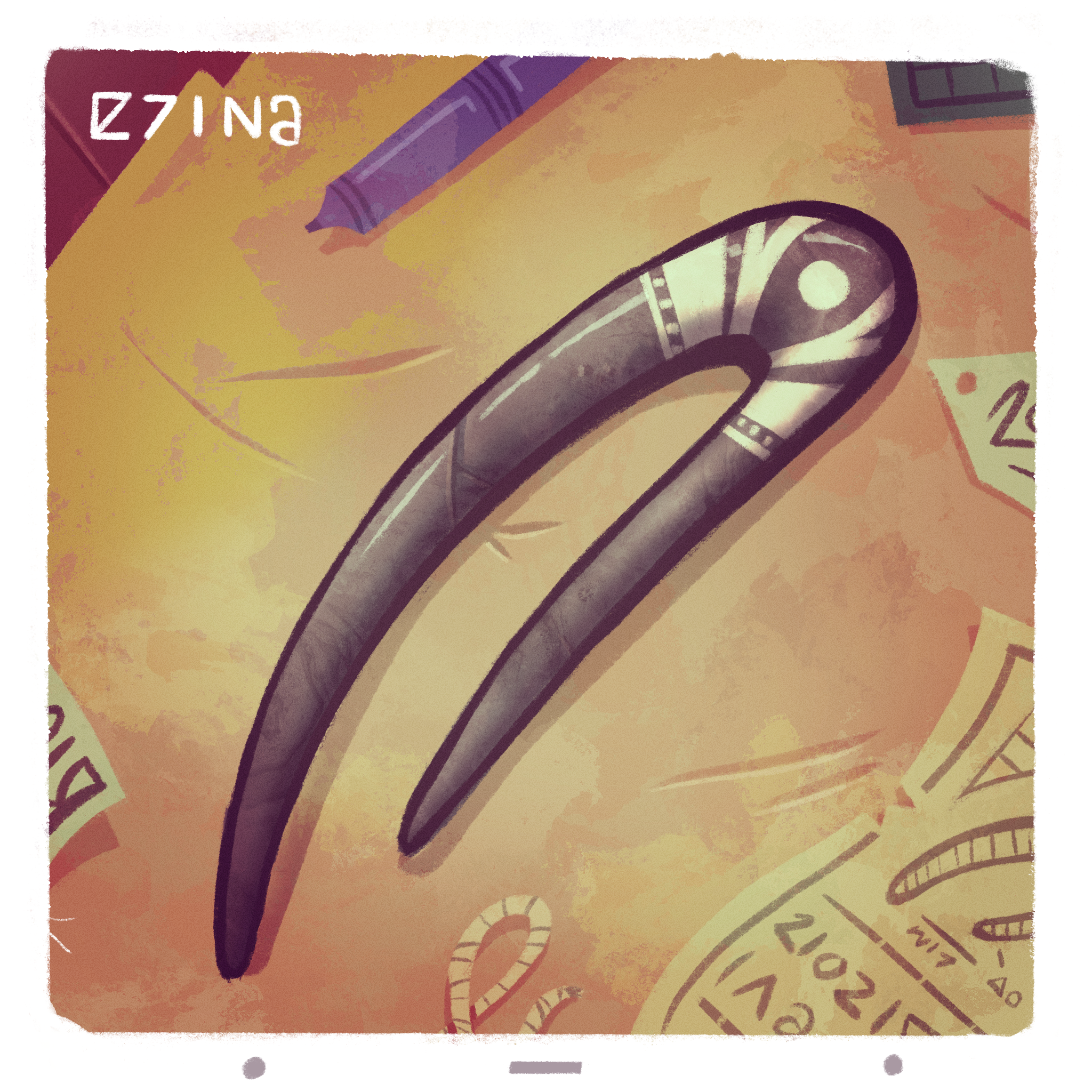
What is unusual, however, is that I should find myself writing an entry for this archive specifically about a culture I have never encountered directly. My only contact with the Masreki people has been a single wooden hair pin, humbly decorated and weighing almost nothing in my hand.
“Is it very valuable?” I asked Merta, the antiques dealer who was showing me the item. She sucked her teeth, considering the question.
“Depends what you mean by ‘valuable’. Do you know much about the Masreki No? Well. They have this tradition – it’s called ‘dispensiture’. It’s a death ritual, really, though it usually takes place before anyone actually… you know. [laughs]
“I don’t know about you, but sometimes, I look around at all the stuff in my house, and I don’t know how half of it got there. You think the shop’s bad – it’s nothing on my front room!”
I thought of my little cabin on the Guillemot, which had seemed so sparse when I first moved in and which is already filling up with new possessions.
“That doesn’t happen to the Masreki,” Merta went on. “I mean, I’m sure it happens to some of them. But on paper, it shouldn’t.
“See, they have this concept – ‘techudin’, they call it. It’s an idea that every object has a-a… A memory? Or an echo? It’s hard to translate, it depends on some complicated ideas in Masreki cosmology.
“The absolutely wrong way to think about it is that there’s the real world, and then the magical world sitting on top like a-a-a piece of ham on bread.”
“Ham on bread?”
“Well, I did say that’s the wrong way to think about it! But it’s how I think about it. It’s a separate layer of reality closely pressed against our own.”
“Sound more like butter than ham.”
“Butter get crumbs in,” Scarry put in from where he was browsing through a catalogue of Merta’s stock.
Merta made a gesture of agreement. “Like ghosts!” she said, incomprehensibly.
I feared we were straying from the point. “What about this ritual?” I prompted.
“Right, yes. So. For the Masreki, every object has an echo in that other layer of existence. And if you place too many objects in one space, it gets… too loud?”
“It’s not about quantity,” said Scarry. “It’s about harmony. Each item in your home or your ship or your office has to be in harmony with the others.”
“Just so. But over time, and specifically use, the harmony, the-the nature of the echo, changes. Items take on something of their owner’s resonance, they become imbued with their personal magical energy. When a person is dying, those ideas lead to two distinct but related issues.
“First, you want to make sure there isn’t too much stuff about. All that magical noise makes it hard for the person’s spirit to move, you see. But at the same time, you can’t just be chucking lifelong beloved items in the bin all chock full of resonant energy.
“So, when a person knows their time is due, they start to clear the home. This is what they call ‘dispensiture’.
“Practical items usually go to someone in the community who needs them. Most Masreki communities have libraries or warehouses of collective resources. They’ll take donations of books or tools and so on.
“There is a ritual process the items have to go through if they’ve been in the home too long, but I-I don’t know the details.”
Not for the first time, I wished I was with an actual Masreki person so I could ask for clarification. But that will have to wait. Merta seemed to be nearing her point, anyway.
“The main crux of dispensiture is the really personal items. The table someone ate breakfast at every morning, or the neck-piece they wore on their wedding day. Something infused with them, that echoes strongly with their life.
“Those items need to be taken care of properly. The person who’s dying, or their nearest friend if they went suddenly, takes time with each object. They sit with them, physically if possible, and pray over them to see who they should go to.
“It’s always an individual. You can’t make these objects communal. And it isn’t about favouritism or practicality. It’s a deeply spiritual choice. Deeply personal.
“Because those kinds of objects never stop resonating. If you inherited one, you wouldn’t donate it when it came time for your own dispensiture. At that point, it’s carrying your energy and the person who gave it to you. You’d pass it on with as much care as they had. And so on down the line for… basically ever.
We each looked down at the hair pin on the desk before us. This little object, passed on with care from owner to owner, a cherished memorial of the past, resonating in harmony with the present. Merta reached out and traced its curve with the tip of one claw.
“There’s nothing particularly valuable about this. It’s made of shakaf wood, which grows all over the Burlat system. It’s not been carved with any particular skill – more homemade than hand-made. And it’s got these little marks on it in Masar – someone’s initials, I think.”
Scarry heaved a sigh. “It shouldn’t be here. It should be with its people.”
I wish I could believe that was his only motivation. “You think they will pay for it?”
Scarry made an irritated sound. He turned away, feigning interest in an antique boot scraper. Merta watched the interaction with open interest.
“How did it fall out of Masreki hands if it is not valuable?” I said, keen to change the subject. Merta moved her body in the equivalent of a shrug.
“There’s value and there’s value. You can get pins like this in any boutique, carved from wood or stone, with enamel decoration or encrusted in jewels.
“But some people get a kick out of, uh, ‘authenticity’. They like the idea of owning something nobody else has, no matter if there’s a good reason for that. I could sell this, easy. The fact it’s a dispensiture piece would only bring the price up.
“Which is why I’m giving it to the gallant captain. He’ll see it safely home.”
Scarry did not look up from the boot scraper. “Giving it to me?” he echoed.
A twinkle came into Merta’s eyes. “I do have expenses to cover!”
It is not how I would prefer the item be returned. I know Scarry’s perspective – the good gets done, no matter the means or the motivation. And perhaps that is the best that can be hoped for in this particular case.
Regardless, I am glad the pin is going back to the people who will most treasure it. It is better, certainly, than being sold on to some collector to crow over its authenticity, lauding a significance they cannot hope to truly understand. And I am grateful for the small part I have had in seeing it on its way.
[Title music: rhythmic instrumental folk. It plays throughout the closing credits.]
H.R. Owen
Travelling Light was created by H.R. Owen and Matt McDyre, and is a Monstrous Productions podcast. This episode was written and performed by H.R. Owen.
This week’s entry to the archives was based on an idea by Toblerones. You can see Matt's illustration for the entry on our social media accounts.
If you've got an idea for the archive, we want to hear it. We accept anything from a one line prompt to a fully written entry through our website, by email, or on social media. For more information, see the show notes.
If you want to support Travelling Light, please consider leaving a review on your podcast platform of choice. You can also make a one-off donation or sign up for a monthly subscription at ko-fi.com/monstrousproductions.
With tiers starting at just £1 a month, all supporters receive bonus artwork and additional content, the ability to vote on audience decisions, and an invitation to the Monstrous Productions Discord server.
This podcast is distributed under a Creative Commons Attribution-NonCommercial-ShareAlike 4.0 International License. The theme tune is by Vinca.
[Fade to silence.]
--END TRANSCRIPT--