Episode 74
Travelling Light E074S02 Transcript
[Title music: rhythmic electronic folk.]
H.R. Owen
Travelling Light: Episode Seventy Four.
[The music fades out.]
The Traveller
4ᵗʰ Enu 851, continued.
The entertainment offerings on the Albothi Station local directory were diverse. I could have spent my day at any one of a dozen concerts, in all manner of musical styles; I could have attended an art show or a historical exhibition; I could even have signed up for a workshop and learnt a new craft.
At least, I could have, if Scarry’s bonus had been significantly more generous – to the tune of four or five hundred percent.
In the end, I could only find two events I could reasonably afford: a theatrical performance offering cut prices for standing-only tickets; and a shako match, a popular Tilfarian sport with riders playing atop large animals.
I went for the shako match in the end, on the simple grounds that I had never heard of it before. And I did try to enjoy myself. But everything about the event seemed designed to make such enjoyment impossible.
I have written more in the attached archive entry. For now, it will suffice to say I left the arena tired and hungry and quite entirely done with Albothi Station.
Ordinarily, I take great care in choosing my accommodation when in a new place. I enjoy comparing listings, considering whether I am in the mood for solitude or community, picking out the perfect spot to suit my taste and needs.
I took no such care on Albothi. I simply searched for a private room within walking distance of the arena and booked myself in, charging the cost to the Guillemot’s account with no qualms whatsoever.
I ordered food to the room – a thing I almost never do – and when it came, I sat on the floor to eat with the lights off and the blinds half shut, revelling in the dark and the quiet and the firmly closed door between me and the world.
I went to bed earlier than usual, for want of anything else to do. Still, it was peaceful, lying there looking at the shapes cast upon the ceiling by the lights outside. I felt some deep tension from the past three weeks finally release.
I am in Tilfar at last. Óli’s next letter should arrive in a few weeks’ time, letting me know whether or not they want me to attend the meeting with their parents. Meanwhile, perhaps I can see something of the world they grew up in.
I must remember that they did not grow up on Albothi. The station is a place one passes through either coming from or going out towards the wider galaxy. Clearly some assumptions are made about who may undergo such a journey.
And not unreasonably, I suppose. Life aboard the Guillemot is not luxurious by any stretch, but it is perfectly comfortable, and I know first-hand that even the lowliest crew-mate is handsomely compensated.
To make a profit while keeping a ship the size of the Gilly fuelled and fairly paying its crew proves how lucrative Scarry’s business endeavours are.
Other merchants visiting Tilfar must be at least as well-off as him, to intend to make a profit after such a journey. And this goes double for tourists or holiday-makers, using private income for private pleasure.
So, no, it is not unreasonable for the administrators and managers of Albothi Station to assume most of their visitors will be well-to-do, if not outright wealthy. But I have been in places with rich people before, and they were not like this.
The values demonstrated here, the lack of community or interest in connecting with one another… It sits ill with me, very ill indeed.
But one cannot judge an entire system by the lights of one station, any more than one can judge an entire culture by one person. There is no reason to believe all of Tilfar is like this.
I cannot expect to learn anything about Óli or their upbringing until we reach Drunvhitur. At least, I… very much hope I will see something different there. I cannot imagine growing up in a world like this.
I came back to the Guillemot after breakfast. A single day cycle was enough to have me keen to get back on board. But there was some small delay in doing so.
It is quite a rare thing for everyone to disembark the Guillemot at once. If we are parked up in one of the less reputable ports at such a time, Scarry can lock the hatch with his personal fob. This programmes the hatch with a higher level of encryption than any of the other crew’s devices for an added layer of security.
As I say, it is not usually necessary. I have never known Scarry to use his own fob in any port with a decent security system of its own, or even just when there are plenty of neighbouring crews docked nearby to keep an eye on things. And yet, he used it on Albothi.
“I don’t know!” Scarry groaned when I asked him what, exactly, he thought was going to happen to ship in his absence. He was sat on a crate in the docking bay, head in his hands. “I wasn’t thinking!”
Tarlin, who arrived shortly after I did, gave him the sort of withering look only a parent can deliver. “I think the ‘not thinking’ part was later, actually.”
She was referring to the moment when, upon returning to the ship in an uncharacteristically ebullient mood after a night alone in a fancy hotel, Scarry tossed the fob into the air, bounced it off the inside of his elbow, and promptly fumbled the catch, knocking the fob – and our only means of ingress to the ship – into a nearby drainage grate.
“I think I’ve nearly got it!” Resimus called from where they were fishing about in the grate with a bit of wire they found on the dockside. Given that they had said the same thing several times since they began their retrieval attempt, everyone ignored them.
“Can we not get port maintenance down to help?”
Scarry pulled an eloquent face.
“Oh, would you just pay them?!” Tarlin snapped.
“We don’t need to pay them! Resimus has nearly got it!”
On cue, Resimus piped up. “Oh, I think I-! Wait, no, there it goes again…”
He did pay, in the end, though it was another hour before port authority finally sent someone over.
“And here I was, hoping for a speedy departure,” I said, as a burly Achob person in an Albothi Station boiler suit began laboriously unscrewing the grate cover.
I was sat beside Scarry on his crate by then, and he squeezed my knee, rubbing his thumb over it apologetically. “Not your sort of place, I know. But needs must.”
I leant against him, my grumpiness subsiding. “I forgive you. Tarlin might not.”
By the time we finally got aboard, we had missed our original departure time and had to pay – of course – for a new one. But no matter. It gave me time to write to you all before we leave.
We are not going far – only down to Fjirding, a tiny planet that lies closest in the system to Albothi. It will be a great pleasure be back planet-side. I long for fresh air and full sky above me.
And I am looking forwards to seeing more of Tilfar – something of how ordinary people may live in this corner of the galaxy. I love you all. I will write again soon.
[The click of a data stick being inserted into a drive that whirs as it reads]
The Traveller
Entry EN85104-2. A shako match, as seen on Albothi Station.
Key words: Albothi Station; kosi; shako; sport and recreation.
Notes:
My first introduction to the sport of shako was while browsing the Albothi Station local directory. The game has its origins on the planet Esti, in the mountainous region of Inura District.
Kosi are one of the principle livestock species in the region – great shaggy beasts evolved to survive the bitter winds and high altitudes of mountain living.
As well as being a source of milk, meat and wool, the kosi provide transportation for their farmers. And, as happens with any form of transportation, eventually people began to find ways to turn riding into competition.
There are kosa races and even kosa trick riding. But by far the most popular kosa-mounted sport is shako, a fast-paced, team-based game that can now be found all across the Tilfar system.
Shako is so popular, it is one of vanishingly few activities on Albothi financially subsidised by station administration. Public funds pay for the upkeep of Beldur Arena, a dedicated shako stadium with a capacity of some 1,500 seats.
I am all for public sporting events. They are an excellent way to bring people together and develop community bonds. But I had seen no evidence at all that Albothi Station administration put any effort into supporting residents to connect with their neighbours.
So when I saw the ticket prices were also subsidised, my first reaction was one of suspicion. I know why I would choose to make such an event as accessible as possible. It did not seem likely anyone in charge on Albothi would share my views.
As soon as I entered the arena, the explanation presented itself. Posters and ad-screens lined the barriers around the pitch and plastered every wall. Every seat was sponsored, bearing a logo and tag-line for some company or another.
Even the pitch itself – a triangle of some 200 metres on each side – was lit with projected advertisements so that the players and their mounts rippled and flashed beneath the brand names.
I struggled to follow the game. The projections made it very hard to see what was happening, and it was made worse by the stop-and-start nature of the game.
Every five minutes, sometimes less if there was a natural breakdown in play, the match came to a full stop. And every time, there followed ten to fifteen minutes of advertisements flashing across the massive screen above the pitch.
I nearly left. But I had seen enough of the game that I did want to learn more. So I did what I always do in unpleasant situations; I looked for someone to talk to.
The stands heaved with spectators, not bothered in the slightest by the flashing lights and blaring jingles. Most were in groups, but one person standing near me appeared to be on her own.
She was decked out in official team merchandise, and spent ever moment of activity on the pitch utterly enraptured, only to slump into disinterest whenever an ad break began.
The next time the game paused, I introduced myself. Her name was Gjodur and she looked me up and down with a sceptical expression.
“Who are you supporting?”
“Nobody. I have no idea who is playing.”
“Ah, don’t worry. You’ll be a Mavs fan by the time I’m through with you!”
The Mavs were the Druble Mavericks – Gjodur’s favourite team.
“Not favourite!” she corrected. “The best! Alright, we had a dry spell when Faranelle took over management, but since we traded for Bakker and moved Pilsen up into t’forward where he belongs, we’ve had back to back triple wicks!”
Before I could ask for some clarity, the game picked up again, and Gjodur’s attention snapped back to the pitch.
“Have his eyes, Karanin! Up on him!”
I watched as a Maverick player – Karanin? – rode her kosa up alongside one of her opposition. She squatted against the kosa’s back before driving upwards, shouldering her opponent sideways and forcing him to drop the ball he carried.
Karanin wheeled her mount around. The ball was a big, heavy thing with a loose cover to help the players hold it, designed to land without bouncing. As she drew close to it, Karanin flung herself out of the saddle, her kosa still running full tilt, and hung on for dear life as her feet trailed along the ground.
As soon as it was close enough, she grabbed the ball with her feet and, in a movement so fluid I almost missed it, flicked both it and herself upwards, landing in the saddle as she caught the ball in her arms.
It was an astonishing display of-of bravery, athleticism and skill. I cheered. I have no idea if I was supposed to, but the arena was so noisy it cannot have made much of a difference.
“Where is she-?” I began, but Gjodur waved me to silence.
“Not in the middle of a run!”
That was me told.
As soon as the next break began, I told Gjodur about the archive, and invited her to please tell me more about the sport she so obviously loved.
“Greatest sport in the galaxy! A team is six riders; two forwards, two mids, two backs. Each match has three teams and three rounds, so each team takes a turn to start the round in possession of the bodra.”
“That is the ball?” I clarified.
“Aye. Used to be a duck in a basket, but they changed it.”
“Wait, what?”
“Each point of the pitch has a ring hanging from a pole, split into three sections. You get one point for putting the bodra through the outside section, two points for the inner section, and three for the very middle.”
“Sorry, can we go back to the duck?”
Gjodra gave no sign she had heard me. “You can only hold the bodra for ten seconds, then you have to pass. You can take possession by intercepting the pass, ripping from another player, or checking them to make them drop it.
“If you do drop it, you have to have at least one foot on the ground when you pick it up. If you don’t have feet, you have to sort it out with the SNA – the governing body. Elect a different limb or work out an accommodation or something.”
She was clearly very passionate about the subject. “Do you play yourself?” I asked.
For the first time, something other than fierce joy came into Gjodur’s expression. “No. No, i-it’s not the sort of sport anyone can play. It’s for the higher ups, you know. People who can afford a kosa and the SNA membership and all that.”
“But it was invented by farmers. And you could play on vehicles, could you not?”
“SNA won’t allow it. They say it’s not shako unless it’s on kosi, and what they say goes. Besides – where am I going to find the space to train, eh?”
I thought of the average size of ordinary living quarters on a space station. I thought of the number of people who could be housed in the square footage of a 1500-seat arena; of the water and energy needed to keep a real grass pitch.
I thought of community halls with the pitch markings of a dozen different sports painted onto their floors, ready to be used for whatever purpose the local people wanted. And I thought of the simple joy of play and friendly competition.
The players were returning to the field. The match would restart any moment.
“I think I have to go,” I said. “But it was lovely to meet you. Up the Mavs.”
The last traces of sadness melted from Gjodur’s face. “Uppa Mavs!” she roared
I pushed towards the exit, making a mental note for whenever I was somewhere quieter to look up that business with the duck.
[Title music: rhythmic instrumental folk. It plays throughout the closing credits.]
H.R. Owen
Travelling Light was created by H.R. Owen and Matt McDyre, and is a Monstrous Productions podcast. This episode was written and performed by H.R. Owen.
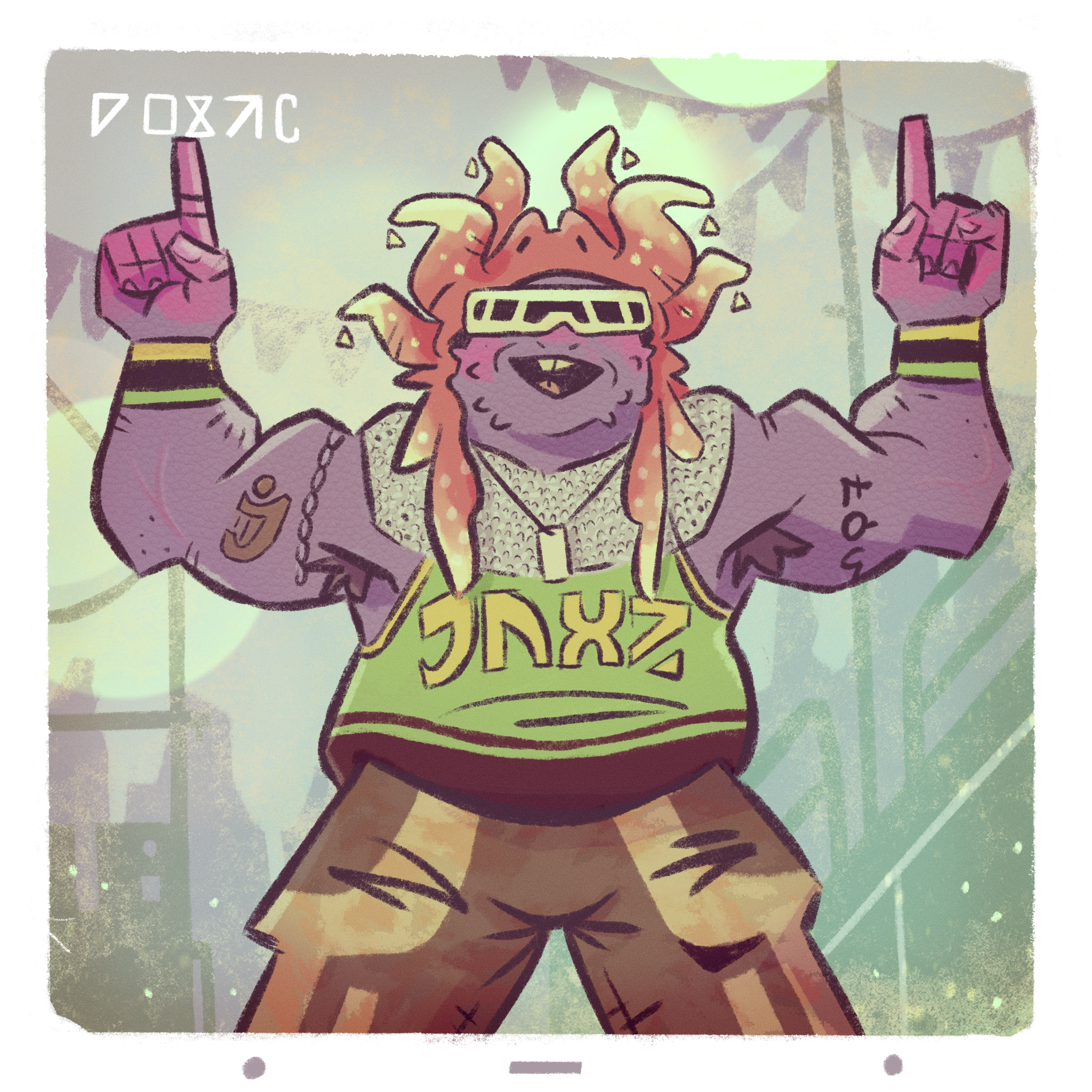
This week’s entry to the archives was based on an idea by H.R. Owen. You can see Matt's illustration for the entry on our social media accounts.
If you've got an idea for the archive, we want to hear it. We accept anything from a one line prompt to a fully written entry through our website, by email, or on social media. For more information, see the show notes.
If you want to support Travelling Light, please consider leaving a review on your podcast platform of choice. You can also make a one-off donation or sign up for a monthly subscription at ko-fi.com/monstrousproductions.
With tiers starting at just £1 a month, all supporters receive bonus artwork and additional content, the ability to vote on audience decisions, and an invitation to the Monstrous Productions Discord server.
This podcast is distributed under a Creative Commons Attribution-NonCommercial-ShareAlike 4.0 International License. The theme tune is by Vinca.
[Fade to silence.]
--END TRANSCRIPT--