Episode 77
Travelling Light E077S02 Transcript
[Title music: rhythmic electronic folk.]
H.R. Owen
Travelling Light: Episode Seventy Seven.
[The music fades out.]
The Traveller
Entry NI85106-1. The architecture of the Ranvhitir official residence.
Key words: architecture; Drunvhitur; places and landmarks; Fjarvil; Tilfar.
Notes:
Drunvhitur is a planet of water. From the black, it seems a sparkling drop, pure unbroken blue against the dark. As the Guillemot came in to land, I watched the blue widen into an ocean, finally growing to fill the window altogether.
Up close – by which I mean, from high above in the planet’s atmosphere – one can make out patches of dark against the blue: archipelagos scattered over the planet’s surface like freckles on sun-kissed shoulders.
These archipelagos are where most of the planet’s inhabitants make their homes. The largest is Sokki archipelago, but we were bound for Fjarvil – not the most populous perhaps, but by far the wealthiest.
The local directory informed me there is no planetary capital on Drunvhitur. The archipelagos enjoy complete autonomy, it said, with equal standing on the international stage. This is a polite fiction. The Tilfar system is full of them.
Fjarvil is the centre of politics on the planet, and while not the actual site of much trade, it is the cornerstone of the planet’s economy.
We came across another polite fiction at the docks, where Captain Scarry and I were met by a representative of the Ranvhitir family. We were to go with them by private transportation to the official residence – for our own comfort, of course.
The representative was a stony-faced pillar of a person in sombre robes embroidered in the complex textile language of Tilfarian culture. A slight familiarity in the patterns made me wonder if they were a minor member of Ranvhitir House. I did try to ask. But they were not inclined to conversation.
We slipped silently through Fjarvil City, its streets as often water as they were paved. I watched out the window and wished I could have made my own way.
The city was full of people walking and sailing, chatting to their neighbours and going about their lives. Every glimpse down this street and that promised something interesting to see, someone interesting to talk to. But we had an appointment to keep.
The transport took us away from the bustle of the city. The streets broadened into wide, empty avenues with buildings set further and further back from the road until they vanished entirely behind towering walls of thick-leaved foliage.
Finally, we came to the gates of the official residence of Ranvhitir House. We were over water at that point, and the transport bobbed gently in the waves as the gates cycled open to admit us.
I was expecting gardens, or perhaps a-a sweeping drive lined with elegant trees, as the drive to the Assembly in Emerraine is lined with pistachio and flowering cypress. Instead, we came into an even larger body of water – a lake, in point of fact, surrounding the island where perched the official residence.
Aquatic plants covered the surface of the water, bright green leaves filling the space between flowers of pink and blue and purple. I looked behind us, and saw the blue-black ribbon of our wake narrowing even as we carved it, the plants rushing in to fill the space like breath filling lungs.
It took five minutes to cross the lake. I saw no bridges.
The transport brought us to a sloped jetty, one of several this side of the island. We drove smoothly up onto land and continued down a winding road that cut through the trees and vegetation that grew thick to the water’s edge.
I found myself thinking through these layers upon layers like a children’s rhyme. First, the sea; then the city in the sea; then the lake inside the city in the sea; then the island on the lake inside the city in the sea; then the gardens on the island; then the house within the gardens; and then the child within the house…
This was ringing round in my head when we broke out at last into a stretch of cleared land around the residence itself. We got out of the transport, finally, and made our way towards the broad sweep of steps that led to the lower floor.
The Ranvhitir residence is considered a paragon of Fjarvilian architecture. It was built some four centuries ago, when the Ranvhitir family moved to Fjarvil from their old residence in Sokki.
Like many of the buildings we had passed in Fjarvil City – a lifetime ago now, it seemed – the residence was a wooden building constructed with a colonnaded lower floor beneath several tiers of other floors above.
The weather in Fjarvil tends to muggy heat, and the lower floor is traditionally a place for family and friends to gather out of the sun’s glare.
I could have fit everyone I have ever called a friend and every relative I have in the lower floor of the Ranvhitir residence and still not filled it. It resembled more a public square than a home, full of people in official robes discussing the matters of the day.
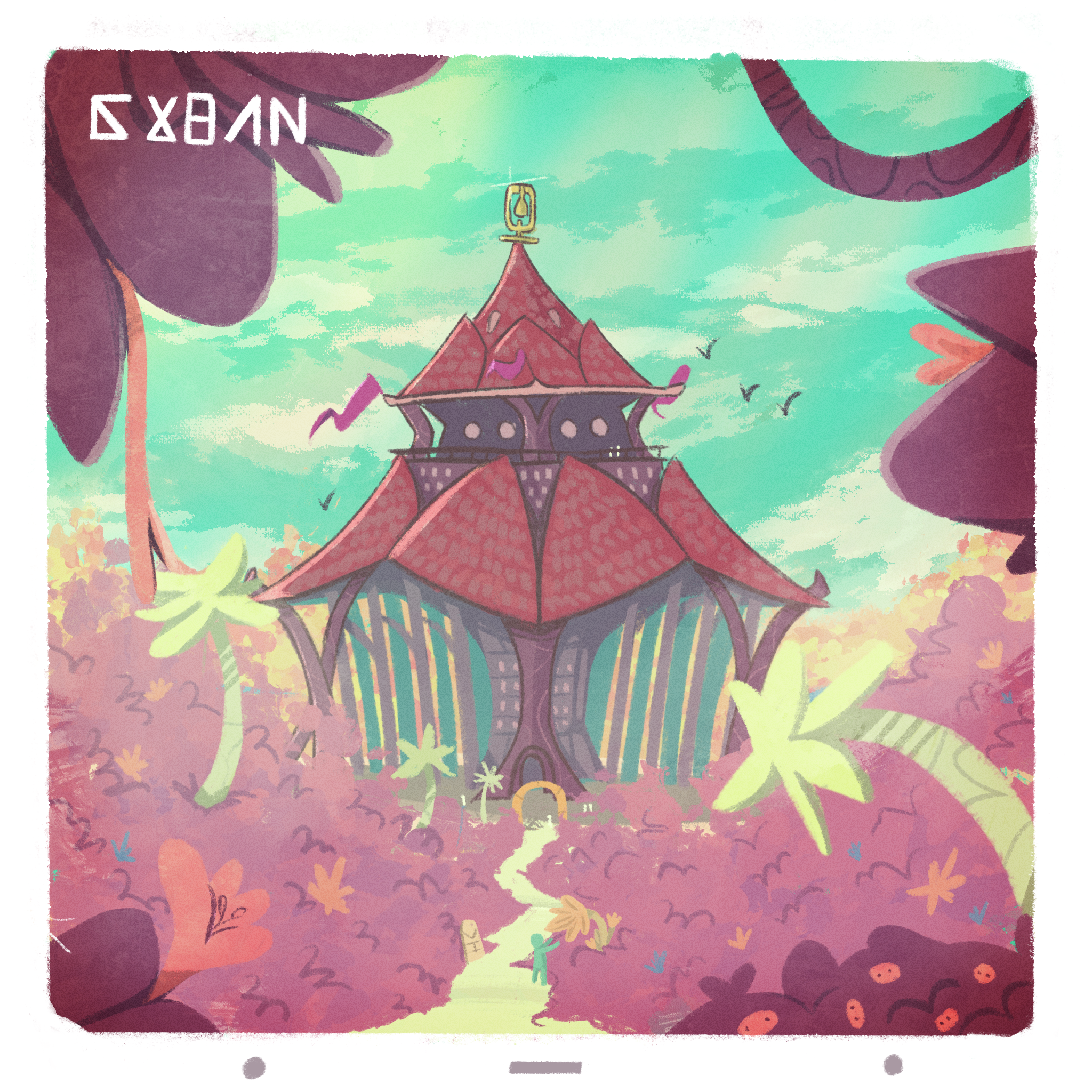
The upper floors staggered into the sky, each topped with a curly-cornered roof tiled in a red so bright and shining it looked like wet paint. Or blood, if you want to be dramatic. And I do think the residence meant to be dramatic.
Each roof corner bore a bright banner in the Ranvhitir House colours, flashing in the wind. And above it all, a final roof rose in an elongated triangle, curved sides sweeping to a piercing point, topped with a golden bell I am sure was bigger than me, but which looked small as my fingernail from the ground.
As we got closer, I saw the pillars of the colonnade – easily a hundred of them – were intricately carved and painted. The ceiling was high, I could not make out the upper carvings, but I was sure they would be just as fine as the ones below.
I longed to look more closely. They reminded me, in an obscure way, of the murals at Tautha Serran of early Serranites going about their ancient lives.
Our guide caught me looking as we passed, and broke their silence. “They tell the story of Tonirsa, bringing forth the universe from his wheat fields.”
“I do not know that story,” I said. They shot me a cold look.
“Why should you?”
In the middle of the colonnaded space was a pair of double doors set into a square of darkly papered walls. The doors were twice as tall as Scarry and would have allowed ten people to enter walking shoulder to shoulder without touching.
This was the entry to the residence. Not the private rooms, those were at the top of the building, under that great, arcing roof. I wondered what the view would be like from one of those distant windows. I wondered if… you could see the sea.
These doors led first to a staircase. It took us past the first floor, with the kitchens and laundries and offices where the ordinary business of living and government is conducted, and on to the second.
This level is home to a maze of assembly halls and reception rooms, each as glamorous as the last. They are named after great personages of Ranvhitir House, and our guide led us finally to the Thetur Room, named for some great ancestor of Óli’s.
It was an elegant space, full of softly dappled sunlight. The wooden boards beneath our feet were polished to a soft sheen, our footsteps muffled by delicate rugs that would have hung on the walls of any other home.
Intricately carved tracery covered the windows, obscuring the view but letting a warm breeze curl its way inside, bringing with it the smell of greenery and lake water and the sound of banners cracking in the wind.
Growing up in the temple, there were rooms I was not allowed to play in, kept for official visitors or holy rituals. And I will not pretend there was never discordance between the ordinary rhythms of mine and my grandmother’s lives, and the sweeping ritual rhythms of temple life.
But there are door-frames in that temple with lines upon them, marking my height as I grew. There is a notch out of one of the tables in the reception hall where I tripped and knocked out a tooth on its corner.
The trees in the temple garden were so often full of children, my cousins and my friends, I am sure our neighbours thought sometimes we kept a troop of monkeys for pets! [laughs, then sighs]
I was not always happy. No child is. But my griefs were small and temporary, and I was not lonely. Seeing the place the Ranvhitir family call home, I begin to doubt I have ever really been lonely in all my life.
[The sound of the data stick whirring fades in, cutting out when the data stick is removed with a click.]
The Traveller
6ᵗʰ Nisa 851
To the community at Emerraine, who carry the light.
After long consideration, I decided to take Óli at their word. If they will not share their thoughts with me, I can do no better by them than trusting what they do tell me. So, I did as I wished. I attended the meeting with their parents.
We were brought to the residence by a representative of the family. Scarry and I were in our most formal clothing, going against both our preferences. I had to run out yesterday after we landed and pick something up new as I had nothing appropriate in my luggage.
I felt stiff and awkward in the unfamiliar clothes. As we waited for Óli’s parents to join us in the reception room, I could not stop fidgeting, pulling at my embroidered cuffs and bouncing in the too-tight shoes.
Scarry said my name once, his voice calm but firm. “Settle down.”
“Easy for you to say,” I shot back. “You have done this before. You had the suit ready and everything.”
He had pulled it from the back of his wardrobe, obviously kept on hand for such occasions. It was finely cut from lustrous dark cloth, with a sweeping jacket that fell past his knees. He looked horribly handsome in it, which only made me crosser.
[sighing] Naturally, he declined to answer, keeping his thoughts to himself, as he had all morning. He turned to look broodingly out through the window tracery. I went over the things I wanted to say to Óli’s parents in my head, and tried to breathe evenly.
First, I hoped to reassure them. There is no way such a breakdown in the relationship with their child could be easy. But I could at least give them the comfort of knowing Óli is well and happy and among friends.
I would not presume to guess Óli’s feelings or try to make less of their decision. But they told me to do as I like, and I felt moved to offer whatever kindness I could.
And, if the conversation went in a way that made it feel possible… Well. I admit, I had… questions. I wanted to know their understanding of the situation, how they felt the relationship had come to this.
Of course, those are bigger questions than one can put to anyone on first meeting them. But perhaps, if I could get them to open up a little, I could gain some insight-
The door to the reception room opened. Óli’s parents walked in.
There were three of them: their pathir, Havín; their nothir, Agda; and their ithir, Éla. I watched their faces as they entered, trying to see Óli in them. And I-I could, I think, a little.
The tilt of Éla’s mouth was different but those were Óli’s lips. They have Havín’s cheekbones, and Agda’s hair. But there was so much else going on, so much jewellery and make-up and… [sighs] And the expressions… They were not like Óli’s at all…
They were all tall, Agda heavy-set and Éla bordering on skinny. Only Havín had Óli’s willowy strength. And all carried themselves with an imperious certainty I recognised from when Óli is in a temper.
Agda was the first to speak.
“Where is our child?” she snapped. “Why are they not here?”
Her eyes were fierce and hard, not like Óli’s at all. Scarry met them steadily.
“They declined to return with me, your eminence.”
An icy silence followed his words.
“We were not paying you for them to decline.”
“Oh, shut up, Havín,” drawled Éla. They had thrown themselves down on a couch as if the conversation were unutterably boring. “He could hardly kidnap a scion of the house, could he? If Óli will not come, they will not come.”
“What did they say?” Agda demanded. “Their exact words.”
“They told me they were the scion of Ranvhitir House, and declared their cloak would stand as proof of this fact. Then they told me to take, uh… Uh, ‘Take my robe,’” Scarry recited, “‘and with it, my self.’”
He made a gesture, and I stepped forwards with the box I had been carrying. I had not wanted to give it over to anyone. I laid it on a low table in front of the sofas, and lifted the lid. Óli’s cloak lay within, gleaming slightly in the sunlight.
“‘Return it to them, and with it, all ties between us. They no longer have a child by my name. I renounce them, and all that bonds us.’”
The silence was softer now. I kept my eyes down, giving them all what privacy I could offer. My eyes rested upon the robe, its fine embroidery telling the tale of Óli’s life – to a point. It was a beautiful object, for all the weight it put upon its wearer’s shoulders.
A noise cut through my thoughts. Éla was laughing.
[laughing] “They get that from you, Havín. The melodramatics.”
“Ranvhitir House does not renege upon its duties,” Agda declared. “What was their reason?”
“I did not presume to ask,” Scarry started, but Havín interrupted.
“Oh, you know the reasons. It is always the same with that child. You say anything, offer any advice or dare to suggest they are not behaving as befits their station, and suddenly, oh, you are the cruellest parent a child has ever had! Ungrateful little toad!”
Éla inspected their impeccably manicured nails. “Sensitive,” they offered. “They have always been so sensitive.”
Colour rose on Havín’s cheeks, tears in her eyes. Agda moved towards her, and I thought she would perhaps take Havín in her arms? Offer some comfort? But she stopped a few paces short, unable or unwilling to close the distance.
“Gerta’s girl is next line for succession,” she said simply. “We shall have to have her formerly inaugurated.”
“At least someone in this family knows how to behave,” said Éla.
“Where are they?” Agda demanded, suddenly turning her attention on Scarry.
The two were of a height, and while Agda was not as broad as Scarry, she had undeniable physical presence. I could see her tapping into it, making herself seem larger either consciously or as a thoughtless expression of power.
Scarry was unperturbed. “I don’t know,” he lied, with perfect simplicity. “We met on Belasir but they had no plans to remain there.”
I had to swallow hard against surge of emotion at his words. Belasir is long way from Kerrin. A very long way.
Agda looked long and hard at Scarry. I think she could sense the lie. Or perhaps she was just doing what my grandmother used to do, and making it seem as if she knew so the truth would inevitably tumble out. Not that there was anything of my grandmother in this woman. In any of these people. [sighs]
Scarry is made of pretty stern stuff, and it was Agda who broke the moment, turning away with a gesture of dismissal. She moved on to the matter of Scarry’s payment. I said nothing, in the end. There was no point. There was… [sighs] There was nothing there to speak to.
I kept my silence on the walk back to the transport, or during the ride back to the ship. I wanted to get back to my cabin and take these stupid clothes off. I wanted to see Óli. I wanted to tell them how sorry I was for… [sighs] For all of it.
I was staring out of the transport window, hardly seeing the city as it streamed by, when a movement caught my eye. Scarry was in the seat beside me, and when I turned I found him watching me, brows knit in a complicated expression.
The movement I had seen was his arm. It sat in the space between us as if he had gone to touch me and changed his mind. He reached out and squeezed my knee. Tears prickled in my eyes.
“Oh, sweetheart,” he sighed. “Come here.”
And quite heedless of the Ranvhitir official in the front seat, he pulled me into his lap, holding me close.
“What was Tarlin like as a mother?” I asked, when I felt able to speak.
“Exactly the same as she is now. Mad as a balloon. And smarter than she thinks. Nosey. Generous. Kind.”
I kept my eyes on the window, the docks just coming into sight. “I am glad.”
His mouth was warm where it pressed against my temple. “Me too.”
[Title music: rhythmic instrumental folk. It plays throughout the closing credits.]
H.R. Owen
Travelling Light was created by H.R. Owen and Matt McDyre, and is a Monstrous Productions podcast. This episode was written and performed by H.R. Owen.
This week’s entry to the archives was based on an idea by H.R. Owen. You can see Matt's illustration for the entry on our social media accounts.
If you've got an idea for the archive, we want to hear it. We accept anything from a one line prompt to a fully written entry through our website, by email, or on social media. For more information, see the show notes.
If you want to support Travelling Light, please consider leaving a review on your podcast platform of choice. You can also make a one-off donation or sign up for a monthly subscription at ko-fi.com/monstrousproductions.
With tiers starting at just £1 a month, all supporters receive bonus artwork and additional content, the ability to vote on audience decisions, and an invitation to the Monstrous Productions Discord server.
This podcast is distributed under a Creative Commons Attribution-NonCommercial-ShareAlike 4.0 International License. The theme tune is by Vinca.
[Fade to silence.]
--END TRANSCRIPT--